Challenge
Starting point
Many employees do not report problems because they fear nothing will change and doubt their anonymity. Companies need a tool that enables safe reporting of irregularities and supports compliance with regulations.

Case study · Product
A web and mobile application for confidential reporting of irregularities, aligned with the Whistleblower Protection Directive and launched within days.

Challenge
Many employees do not report problems because they fear nothing will change and doubt their anonymity. Companies need a tool that enables safe reporting of irregularities and supports compliance with regulations.
Solution
We implemented whiblo: an application composed to fit the organisation, with an anonymous communication module, advanced validation of reports and a two-way correspondence system with the whistleblower.
Benefits for the client
The same change looks different to someone in the field, to management and to the audit. That is why we describe it three times.
The anonymous communication module makes it possible to report a matter and answer questions without revealing who you are.
Form validation reduces gaps in a report, and two-way correspondence makes it possible to ask for details.
Analysis and reporting show what is happening in the channel on an ongoing basis.
Results
A practitioner’s view
More reports after a channel is launched does not mean the organisation has more problems. It means they have become visible. An employee who does not believe in confidentiality does not report, and the matter returns later in a harder form.
Trust depends on two things: being able to remain anonymous and getting a response. That is why the channel has two-way correspondence: the reporting person knows the matter has been received, and the handler can ask follow-up questions without learning their identity.
The application in action
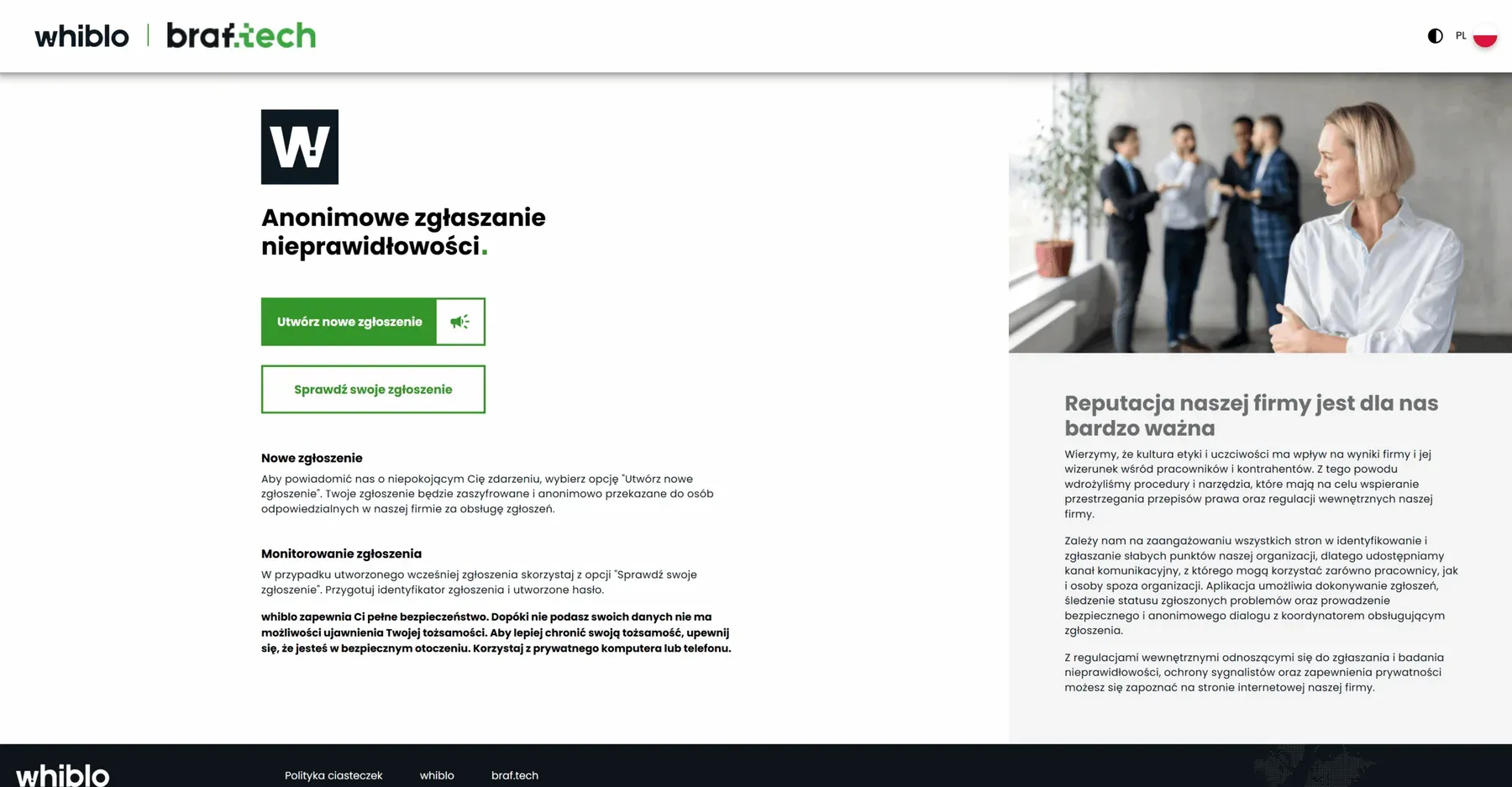
Reporting channel page

Report form

Confirmation that the report was received

List of reports
Tell us about the process you want to put in order. We will show you where it is worth starting.